
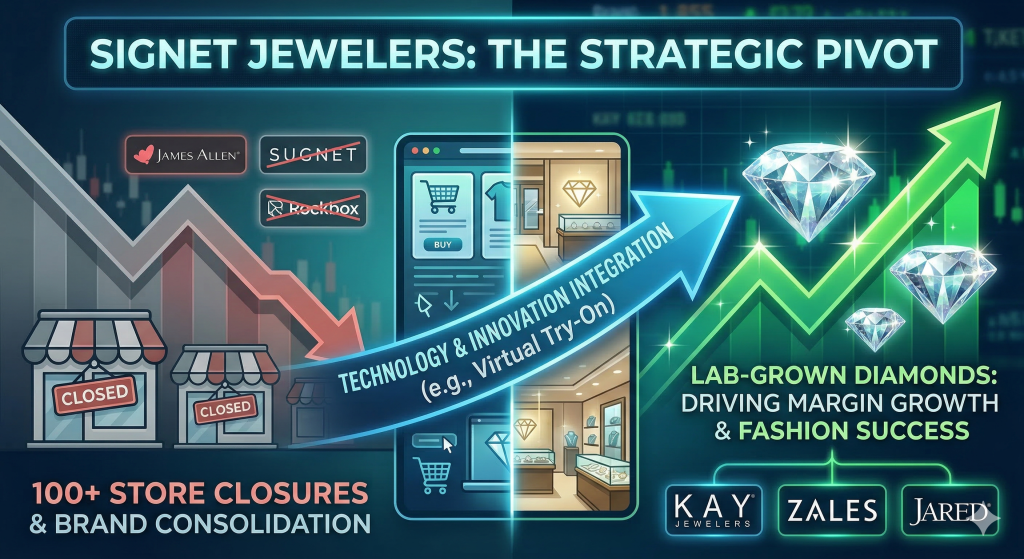
Closures vs. Integration and the LGD Margin Escape Hatch
A tidal wave of closures is sweeping through the retail ecosystem of the world’s largest diamond retailer. This week, we are analyzing the strategic implications of Signet Jewelers’ startling announcement to close 100 brick-and-mortar doors, shutter the subscription service Rockbox, and most notably, discontinue the standalone operations of its landmark digital acquisition, James Allen.
While media commentary has largely fixated on these moves as a simplified retreat or failure, a deep dive into the B2B intelligence—especially in light of Signet’s latest simulated Q4/FY2026 results—reveals a much more sophisticated strategy. This isn’t just about contraction; it’s about “Margin Defense” and the full-scale integration of James Allen’s technology into Signet’s primary banners (Kay, Zales, Jared), with lab-grown diamonds (LGDs) acting as the economic engine.
The End of James Allen: Integration over Elimination
The closure of James Allen as a separate brand is the most significant news for the digital sector. Media analysis quickly noted the redundancy of James Allen (which focused primarily on the natural engagement market at the time of its 2017 acquisition) alongside Blue Nile (which Signet acquired in 2022).
Signet’s CEO, Virginia Drosos, clarified the strategic move: “We are sunsetting James Allen as a standalone e-commerce platform and Rockbox to focus capital on our high-volume, high-margin banners.”
The Real B2B Play: Signet isn’t deleting James Allen; it is harvesting its “Visualization Tools.” The platform’s advanced 360-degree, 10x magnification visualization technology—which pioneered the online LGD e-com segment—is now being integrated directly into the physical Kay and Zales “bridal bars.” This creates a truly integrated, “factory-to-finger” experience. For B2B suppliers, this means Signet requires “Digital Twins” (3D scan files) for all incoming high-quality LGD center stones as standard procedure.
Results Analysis: LGDs as the “Margin Cushion” for Closures
The closures are being executed against the backdrop of a tough natural diamond environment. While Signet’s overall revenue and net income were down (due in part to the prolonged “engagement gap” in the US market, which natural diamonds dominate), lab-grown diamonds were praised as a key strategic winning category.
Margin Expansion: Signet explicitly shared that its success with LGD fashion jewelry helped expand overall merchandise margins by 90 basis points, partially offsetting natural stone headwinds. LGDs are no longer just a value play; they are a necessary tool for stabilizing retail gross margins as raw gold and operational costs rise.
Higher AUR: The success of LGDs in self-purchase fashion collections (sub-$1,000) is driving higher Average Unit Retail (AUR). By offering larger, accessible LGD stones in pendants and earrings, Signet is successfully upselling the fashion-conscious consumer.
** Bridal Resilience:** While total engagement units were flat to down, total sales value for bridal remained stable, thanks to consumers opting for larger LGD center stones to hit a comfortable budget.
B2B Market Intel Action Items:
Supply Chain Split (The Blue Nile Factor): While James Allen is closing, Blue Nile is being prioritized as Signet’s “Digital Flagship.” This signals that Signet is positioning Blue Nile as its high-end, bespoke LGD/Natural hybrid platform. Suppliers of large (3ct+), premium LGD center stones with specialty “long fancy” cuts should focus their efforts on the Blue Nile vendor pipeline. Suppliers of high-volume, matched-pair LGD melee (0.50ct–1.0ct fancies) should align with Kay/Zales replenishment programs.
The New Inventory Profile: The closure of 100 physical stores will trigger a significant inventory rebalancing event. Midstream suppliers should expect a sharp (but temporary) drop in total order volume as Signet digests the stock from closed doors. However, new inventory procurement will be laser-focused on high-margin LGD fashion components, prioritizing pre-sorted parcels that reduce labor at the bench.

