
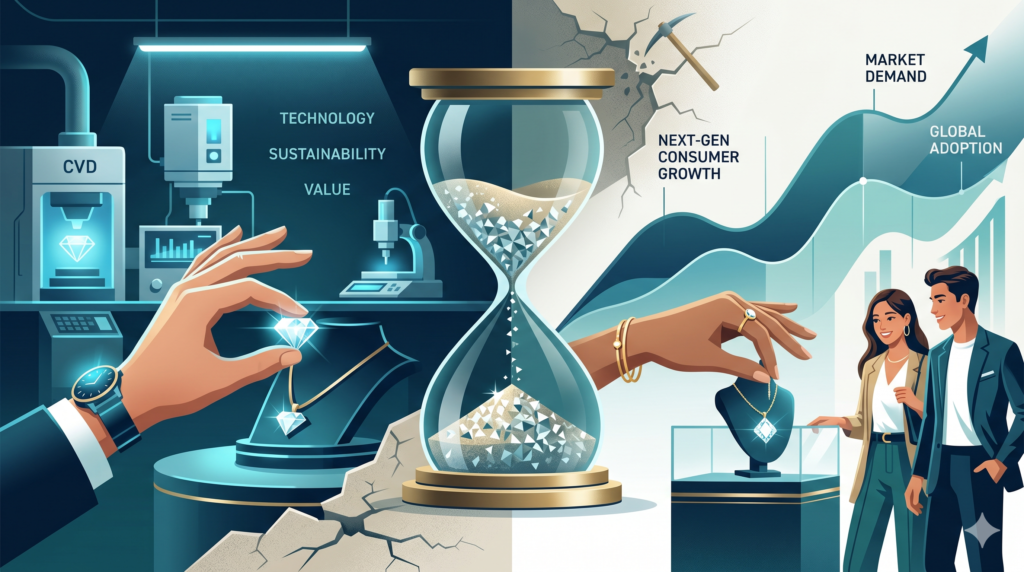
Why the Mined Diamond Industry’s Retaliatory Tactics Won’t Stop the Lab-Grown Momentum
In the past few weeks, the diamond industry headlines have been dominated by a familiar rhythm of “offense and defense.” First, we saw the National Diamond Council (NDC) successfully lodge a complaint resulting in advertising sanctions against a lab-grown diamond (LGD) producer for “misleading” environmental claims. Shortly after, Pandora—the world’s largest jewelry brand—faced predictable pushback from traditionalist quarters after releasing its carbon footprint standard, which starkly contrasted the low impact of its LGD collections against the heavy environmental toll of industrial mining.
To the casual observer, it looks like a high-stakes legal and PR war. But for those of us tracking B2B market data and consumer sentiment, this is all beginning to feel like “much ado about nothing.” While the traditional industry spends its resources on litigation and semantic policing, the next-gen consumer is busy making their preference known at the cash register.
The recent sanctions regarding advertising terminology are, in the grand scheme, a tactical distraction. While it is vital for the LGD industry to maintain transparency and adhere to rigorous FTC guidelines regarding “eco-friendly” claims, the traditional industry’s focus on these technicalities misses the forest for the trees.
The mined diamond sector is attempting to use regulatory bodies to turn back the clock, hoping that by stripping LGD of certain adjectives, they can restore the “prestige gap” that once protected their margins. However, these efforts fail to account for the fact that the shift toward LGD isn’t just about marketing—it’s about a fundamental shift in value perception.
Pandora and the Data of Disruption
Pandora’s recent announcement regarding its carbon footprint standards for LGD jewelry is a watershed moment. By quantifying the environmental delta between mined and lab-grown stones, Pandora has provided a blueprint for the B2B sector.
Predictably, the mined industry has attempted to poke holes in these metrics. But for the modern retail buyer, the broad strokes are already painted: Lab-grown diamonds offer a transparent, traceable, and significantly less invasive alternative. Whether a stone is “carbon neutral” or “low carbon” is a debate for the legal department; for the consumer, the fact that it didn’t require the displacement of tons of earth is a sufficient differentiator.
The “Next-Gen” Verdict
The most important data point in this entire “war” isn’t found in a courtroom—it’s found in the demographic shift. Millennials and Gen Z now represent the primary demographic for bridal and fashion jewelry globally. This cohort views diamonds through a lens of ethics, economics, and aesthetics, rather than “rarity” myths.
Value over Antiquity
Next-gen consumers are not interested in the “resale value” arguments often touted by the mined industry. They view jewelry as an expression of love or self-style, and they would rather have a 2-carat VVS stone that fits their budget than a 0.75-carat stone that carries a “natural” premium.
Technological Optimism
Unlike previous generations, younger buyers view “lab-grown” as a feat of human ingenuity rather than a “synthetic” imitation. To them, LGD is to mined diamonds what EVs are to internal combustion engines: the logical evolution.
The Bottom Line: Can You Sue a Trend?
The traditional industry’s aggressive stance is a classic “incumbent’s response” to disruption. By focusing on sanctions and attacking the carbon claims of giants like Pandora, they are attempting to protect a monopoly on “romance” that has already been broken.
For B2B stakeholders—manufacturers, wholesalers, and retailers—the noise from the NDC and other legacy bodies should be viewed as a lagging indicator. It is the sound of an industry trying to legislate its way back into relevance. Meanwhile, the LGD market continues to grow because it aligns with the values of the modern shopper: transparency, affordability, and beauty without the baggage.
The “attacks” will likely continue, but they won’t change the trajectory of the market. You can’t litigate away a consumer’s desire for a better product at a better price.
Conclusion
Stay focused on the supply chain, stay transparent in your marketing, and let the legacy industry fight over the dictionary. The future is being grown in the lab, and the consumer has already moved on.

